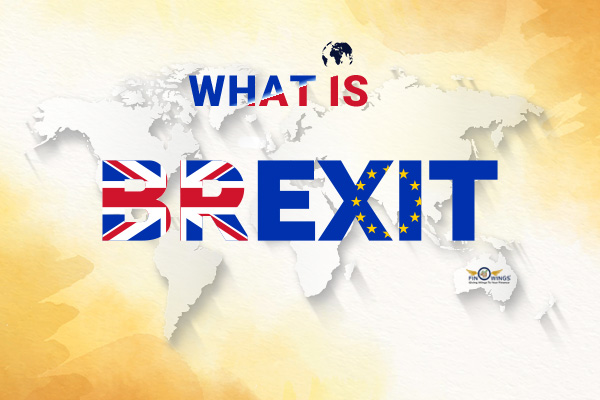
Brexit is the withdrawal of the United Kingdom from the European Union. Voters chose to leave in a referendum on 23 June 2016 by 51.9% to 48.1%.
The UK legally left the EU on 31 January 2020 and left the single market and customs union on 31 December 2020, when the transition period ended.
Since 1 January 2021, UK-EU trade has run under the Trade and Cooperation Agreement.
What Is Brexit? A Simple Definition
Brexit (a blend of "Britain" and "exit") is the political and legal process by which the United Kingdom ended its 47-year membership of the European Union.
The term was coined in May 2012 by Peter Wilding, a British lawyer and — ironically — a pro-EU campaigner, in a blog post modelled on the earlier word "Grexit".
The United Kingdom is not a single country. It is a union of four: England, Scotland, Wales and Northern Ireland. All four left the EU together, even though Scotland and Northern Ireland both voted to remain.
That internal split explains much of the political friction that followed.
Brexit was never a single event. It was a decade-long sequence: a referendum in 2016, a formal exit notice in 2017, a legal departure in 2020, a new trade agreement in 2021, and a slow renegotiation that is still going on in 2026.

Brexit Timeline: How the UK Actually Left

Figure 2 — The road from EEC membership in 1973 to the India-UK trade agreement in 2026.
|
Date |
What happened |
|
1 Jan 1973 |
The UK joins the European Economic Community (EEC). |
|
5 Jun 1975 |
A referendum asks whether the UK should stay in the EEC. 67.2% vote yes. |
|
1 Nov 1993 |
The Maastricht Treaty converts the EEC into the European Union. The UK negotiates an opt-out from the single currency and never adopts the euro. |
|
May 2014 |
The UK Independence Party — founded in 1993, not 2014 — tops the UK's European Parliament election with roughly 26.6% of the vote, pushing EU membership to the centre of British politics. |
|
May 2015 |
David Cameron, Prime Minister since 2010, wins a second term after promising an in-or-out referendum. |
|
23 Jun 2016 |
The referendum: 17.4 million (51.9%) vote Leave, 16.1 million (48.1%) vote Remain, on a 72.2% turnout. Cameron resigns the next morning. |
|
29 Mar 2017 |
Theresa May serves notice under Article 50 of the Treaty on European Union, starting a two-year exit clock. This was the first time any country had used Article 50. |
|
2019 |
Parliament rejects May's deal three times. She resigns in July 2019 — the second Prime Minister brought down by Brexit. |
|
23 Jan 2020 |
The European Union (Withdrawal Agreement) Act receives Royal Assent. |
|
31 Jan 2020 |
The UK legally ceases to be an EU member state. A transition period begins during which EU rules continue to apply. |
|
31 Dec 2020 |
The transition period ends. The UK leaves the single market and the customs union. |
|
1 Jan 2021 |
The UK-EU Trade and Cooperation Agreement (TCA) takes effect — tariff-free and quota-free goods trade, but with customs paperwork, rules-of-origin checks and no automatic services access. |
|
27 Feb 2023 |
The Windsor Framework replaces the contested Northern Ireland Protocol, creating green and red lanes for goods moving from Great Britain to Northern Ireland. |
|
19 May 2025 |
The first UK-EU summit since Brexit produces a Security and Defence Partnership and a "Common Understanding" to negotiate closer ties. |
|
15 Jul 2026 |
The India-UK Comprehensive Economic and Trade Agreement (CETA) and the accompanying Double Contribution Convention enter into force. |
Why Did the UK Vote to Leave the EU?
Six arguments carried the Leave campaign. Understanding them matters, because the same arguments now appear in trade debates in India, the Gulf and Southeast Asia.
1. Sovereignty over lawmaking
EU membership meant a large body of law was made in Brussels and applied directly in the UK, with the European Court of Justice as the final authority. "Take back control" was the campaign's most effective slogan for a reason: it compressed a complex constitutional argument into three words.
2. Immigration and free movement
Free movement of people is a founding principle of the single market. UK governments repeatedly promised to cut net migration to the tens of thousands and could not do so while EU citizens had an automatic right to live and work in Britain. This was probably the single strongest driver of the Leave vote.
3. Budget contributions
The UK was one of the largest net contributors to the EU budget. Leave campaigners argued the money would be better spent domestically. The famous £350 million-a-week figure painted on a campaign bus was a gross figure that ignored the UK rebate and EU spending inside Britain, and was widely criticised at the time.
4. Regulatory burden
Businesses complained that EU rulemaking was slow, procedural and designed for continental economies rather than a services-heavy island economy.
5. Independent trade policy
Inside the customs union, the UK could not sign its own trade agreements. Leaving meant it could — and the India-UK CETA that entered force in 2026 is the clearest example of that argument being cashed in.
6. National identity
A significant share of voters simply did not want a European political identity layered on top of a British one. This is not an economic argument, and it did not respond to economic counter-arguments.

Figure 3 — The UK asked essentially the same question twice, 41 years apart, and got opposite answers.
A point almost every explainer gets wrong
The 1975 referendum was not a "Brexit referendum". It asked whether the UK should stay in the European Economic Community. The European Union did not exist until 1993. Treating the two votes as the same question is a common error — and one the original version of this article made
What Is the European Union? A Quick Primer
The European Union is a political and economic union of 27 member states. It began as a post-war project to bind European economies together tightly enough to make another continental war unthinkable, and grew into the world's largest single market.
Its four freedoms — free movement of goods, services, capital and people — are the core of the deal. A member state that wants full single-market access has to accept all four. That is the trade-off the UK ultimately rejected, and the reason a "soft Brexit" was never available on the terms Leave voters had been promised.
The EU was awarded the Nobel Peace Prize in 2012 for its contribution to peace and democracy in Europe. It also faces genuine structural criticism: slow decision-making across 27 vetoes, a productivity gap against the United States in technology, and the strain of running a single currency across economies with very different fiscal positions. Those criticisms are real. They were also, for the most part, not the reason Britain left — the UK never joined the euro and kept its own currency throughout.
What Actually Changed After Brexit
This is where most explainers stop being useful. Brexit did not simply end a relationship; it replaced one legal regime with another. Three documents govern everything now.
|
Agreement |
What it does |
|
Withdrawal Agreement (2020) |
Settled the divorce terms: the financial settlement, citizens' rights, and the transition period. Also contained the original Northern Ireland Protocol. |
|
Trade and Cooperation Agreement (from 1 Jan 2021) |
Governs ongoing trade. Goods move tariff-free and quota-free, but only if they meet rules-of-origin requirements — and every consignment now needs customs declarations. Services, which are about 80% of the UK economy, got very little. Financial services access runs on an equivalence regime the EU can withdraw. |
|
Windsor Framework (2023) |
Replaced the Northern Ireland Protocol. Goods staying in Northern Ireland use a green lane with minimal checks; goods that might enter the EU single market use a red lane with full checks. |
The distinction that matters
"Tariff-free" is not the same as "friction-free". Under the TCA there are no tariffs on qualifying goods, but there is paperwork, there are border checks, there are rules-of-origin tests, and there are veterinary certificates for food. For a small exporter, that friction can cost more than a tariff would have.
Impact of Brexit on the UK Economy
The honest answer is that the cost has been real but slower and less dramatic than the loudest forecasts on either side predicted. The most widely used estimate comes from the Office for Budget Responsibility, the UK government's own independent fiscal watchdog.

Figure 4 — OBR long-run assumptions for the effect of the post-Brexit trading relationship, relative to continued EU membership.
The OBR assumes the TCA will leave long-run UK productivity about 4% lower than it would have been inside the EU, driven by a roughly 15% reduction in both export and import volumes. It has reviewed these assumptions repeatedly since 2020 and has not revised them. The OBR judges that a meaningful share of that productivity effect is already visible in the data.
Beyond the headline number, four things are observable:
• Trade friction is concentrated in small firms. Large exporters absorbed the paperwork; many small ones simply stopped selling to the EU.
• Business investment was weak through the uncertainty years, and that gap compounds.
• Migration did not fall. EU migration dropped sharply, but non-EU migration rose more, so total net migration ended up higher than pre-Brexit levels — the opposite of what many Leave voters expected.
• The UK gained an independent trade policy and has used it — the CETA with India is the largest example to date.
It is also fair to note that economists disagree about the size of the effect. Critics of the OBR argue the 4% figure rests on cross-country studies that may not transfer well to a mature services economy, and that the global post-2008 productivity slowdown makes clean attribution difficult. The direction of the effect is broadly agreed; the magnitude is genuinely contested.
Impact on the European Union
• The EU lost its second-largest net budget contributor, pushing more of the burden onto Germany, France and others.
• It lost its largest financial centre. Some euro-denominated clearing and trading migrated to Amsterdam, Paris, Frankfurt and Dublin, though London retained more than many expected.
• EU exporters lost frictionless access to a wealthy 67-million-person market.
• Politically, Brexit worked as a deterrent. No other member state has since pursued exit seriously, and support for EU membership rose across the bloc after 2016.
What Brexit Means for India and Indian Investors
This is the section that matters most to a reader in India, and it is the one that global explainers leave out.

Figure 5 — The India-UK trade agreement is the most direct Indian consequence of Brexit.
1. The India - UK trade deal exists because of Brexit
Inside the EU customs union, the UK had no power to negotiate its own trade agreements. The EU and India had been trying and failing to conclude a trade deal since 2007. Freed to negotiate alone, the UK concluded CETA with India in May 2025, signed it in London on 24 July 2025, and brought it into force on 15 July 2026 after both parliaments completed ratification.
Under CETA, roughly 99% of Indian tariff lines get duty-free access to the UK market, covering close to the full value of bilateral trade. Tariffs fall on textiles and clothing, leather and footwear, marine products, engineering goods and auto components, chemicals and pharmaceuticals, and processed foods. The two governments aim to roughly double bilateral trade from around USD 56 billion toward USD 112 billion.
The Double Contribution Convention — the quiet win
Signed on 10 February 2026 and in force alongside CETA, the DCC means Indian professionals on temporary assignment in the UK no longer pay social security contributions in both countries. The exemption period was set at five years, up from the three originally discussed. Employers need a Certificate of Coverage from the home-country authority to claim it. For Indian IT services firms, this is a direct margin item.
2. Which Indian sectors are exposed
|
Sector |
How Brexit and CETA touch it |
|
IT & IT services |
The UK is one of the largest overseas markets for Indian IT firms. Brexit-era uncertainty slowed UK client spending for several years; the DCC now removes a real cost on deputed staff. Check each company's latest investor presentation for current UK and Europe revenue share — the mix changes every quarter. |
|
Textiles, leather, footwear |
Among the largest tariff cuts under CETA. Direct margin benefit for exporters, though competition from Bangladesh and Vietnam remains. |
|
Pharmaceuticals & chemicals |
Duty reductions plus a separate UK regulatory pathway now that the UK sits outside the EU medicines regime. That means a second approval process, not one. |
|
Marine products & processed foods |
Very high pre-CETA tariffs removed, so the proportional gain is large. |
|
Auto components & engineering |
Tariff removal on a category where Indian suppliers already have scale. |
|
Gems & jewellery |
Improved access to a major consumer market. |
|
Education & mobility |
UK universities remain a top destination for Indian students. Brexit ended EU-student preferential fee status, which changed the competitive landscape for international admissions. |
3. How this reaches an Indian retail investor's portfolio
• Currency: GBP/INR movements affect the rupee value of any UK-linked earnings, fees or remittances. Brexit-era sterling volatility is a live example of political risk showing up in a currency pair.
• Indian listed companies: exporters and IT firms with UK revenue see the effect in their reported numbers. Read the segment disclosures rather than relying on headlines.
• International funds: Indian investors can access UK and European equities through international feeder funds and index funds. Note that SEBI's industry-wide overseas investment limits have periodically forced fund houses to pause fresh subscriptions in this category, so availability is not guaranteed.
• Direct overseas investing: Indian residents may remit up to USD 250,000 per financial year under the RBI's Liberalised Remittance Scheme, subject to the Overseas Investment Rules, 2022 and applicable TCS. Verify the current TCS rate and threshold with your authorised dealer bank before remitting.
• Tax: foreign shares and units are taxed under Indian rules regardless of where they are held, and foreign assets must be reported in Schedule FA of your income tax return. Non-disclosure carries penalties under the Black Money Act.
4. A footnote on GDP rankings
Older articles — including the earlier version of this one — say India overtook the UK to become the world's fifth-largest economy. That was true in 2022. It is not the current position.

Figure 6 — Nominal GDP, IMF April 2026 World Economic Outlook estimates.
On the IMF's April 2026 estimates, India is sixth at roughly USD 4.15 trillion, behind the UK at about USD 4.26 trillion and Japan at about USD 4.38 trillion. The slip is not a growth failure — India remains the fastest-growing major economy — but a currency and data-revision effect, since these rankings are computed in nominal US dollars. The IMF's own projections have India moving back ahead over the following years. The lesson for readers is to treat league-table positions as noisy and check the current WEO database rather than trusting a headline from three years ago.
The 2025–26 UK-EU "Reset": What Is Still Being Negotiated
Brexit is not a finished story. Since the Labour government took office in 2024, the UK and EU have been rebuilding parts of the relationship without rejoining the single market, the customs union or free movement.
• At the 19 May 2025 summit the two sides agreed a Security and Defence Partnership and a "Common Understanding" setting an agenda for further negotiation, alongside a twelve-year fisheries access arrangement running to 2038.
• Negotiations on a sanitary and phytosanitary (SPS) agreement — a common food and agricultural standards area that would cut border checks — opened in November 2025, with implementation targeted for around mid-2027. It would require the UK to align dynamically with EU rules in this area.
• A youth experience scheme for 18-30 year olds has been agreed in principle but remains the most politically contested piece, with tuition fees and participant caps unresolved.
• The UK agreed in December 2025 to rejoin the Erasmus+ education exchange programme, with UK students expected to participate from January 2027.
• A second UK-EU summit was scheduled for 22 July 2026 in Brussels but was postponed following Keir Starmer's resignation as Prime Minister. Andy Burnham took office on 20 July 2026, and negotiations are reported to be continuing.
Time-sensitive section
The reset is an active negotiation. Dates, scope and outcomes will move. Re-check this section against the European Commission and UK Cabinet Office before each republication.
Common Myths About Brexit
|
Myth |
Reality |
|
The UK left the EU on 31 December 2020. |
It left on 31 January 2020. December 2020 is when the transition period ended. |
|
The referendum was legally binding. |
It was advisory. Parliament chose to implement it, and passed separate legislation to do so. |
|
Brexit was about leaving the euro. |
The UK never used the euro. It had a permanent opt-out from the single currency. |
|
Brexit cut immigration to the UK. |
EU migration fell sharply, but non-EU migration rose by more. Total net migration is higher than before the referendum. |
|
Brexit means no trade with Europe. |
The EU remains the UK's largest trading partner. Trade continues under the TCA, with added friction. |
|
Brexit has no effect on India. |
The India-UK trade agreement that came into force in July 2026 could not have been signed while the UK was in the EU customs union. |

Conclusion
Brexit is best understood not as a single dramatic exit but as a slow, expensive rewiring of one of the world's largest trading relationships. The vote took a day. The legal separation took three and a half years. The economic adjustment is still running six years later, and the two sides are currently negotiating parts of the relationship back into place.
The verdict on the economics is genuinely mixed, and anyone who tells you otherwise is selling a position. The UK's own fiscal watchdog puts the long-run cost at roughly 4% of productivity. Critics of that estimate say it is overstated. What is not in dispute is that trade with the EU became more expensive and more complicated, that migration did not fall in the way voters were told it would, and that the UK gained a genuinely independent trade policy.
For an Indian reader, that last point is the whole story. The India-UK Comprehensive Economic and Trade Agreement that came into force on 15 July 2026 exists because Britain left the EU customs union. For Indian exporters in textiles, leather, marine products, pharmaceuticals and engineering goods, it is a direct tariff advantage. For Indian professionals working in the UK, the Double Contribution Convention is money that stays in their pocket. For Indian investors, it is a reminder that a political decision taken in another country can quietly reshape the earnings of companies sitting in your own portfolio.
Two practical habits follow from all of this. First, treat league-table statistics — largest economy, fifth versus sixth — as noisy and time-stamped; check the current IMF database rather than repeating a headline from three years ago. Second, when a geopolitical event dominates the news, ask the only question that matters for your money: what does my portfolio actually own, and how much of its revenue comes from the affected market? That question is answerable from a company's own filings, and it is far more useful than any forecast.

DISCLAIMER: This blog is NOT any buy or sell recommendation. No investment or trading advice is given. The content is only for educational purposes. Always discuss with your SEBI-registered financial advisor for investment-related decisions.
Follow this WhatsApp Channel for the latest updates directly on WhatsApp.





.png)